About
History & Organization
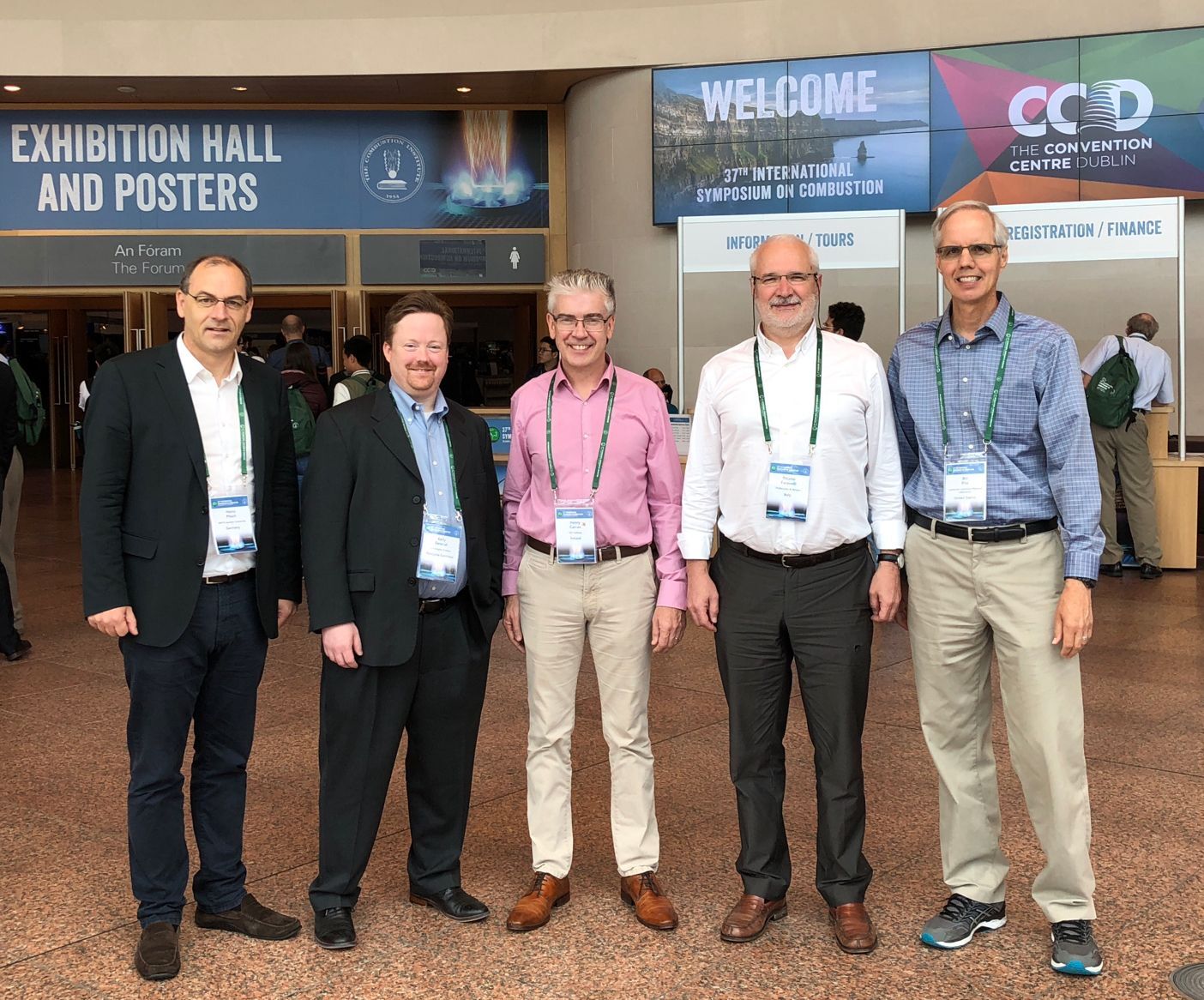
C3 research team leaders at the 37th International Symposium on Combustion
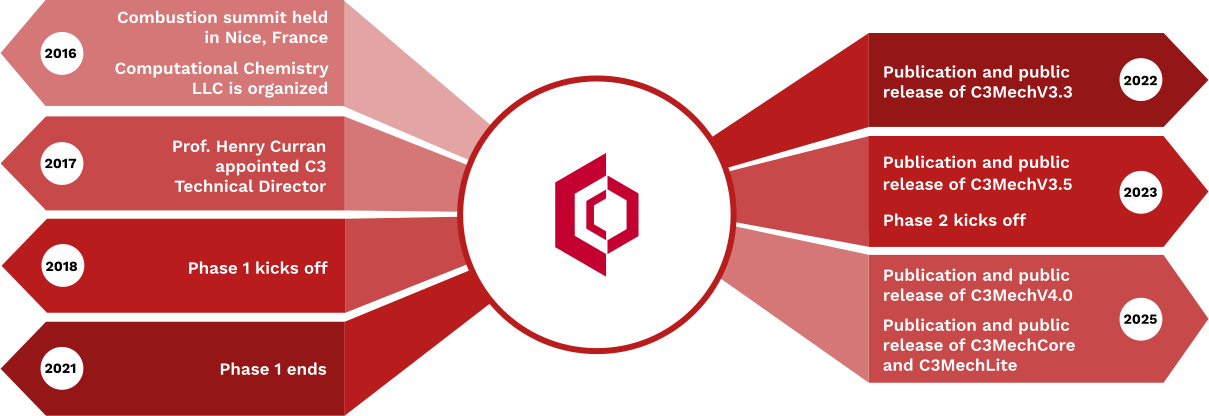
The Computational Chemistry Consortium (C3) was founded in 2016 by Convergent Science, a computational fluid dynamics (CFD) company that develops and supports CONVERGE CFD software. Recent technological breakthroughs at Convergent Science had made it feasible to efficiently couple detailed chemistry calculations with CFD simulations, creating the need for a consistent source from which to obtain chemical mechanisms for different fuels and fuel blends. Recognizing this need, the owners of Convergent Science organized the 2016 Combustion Summit in Nice, France, to bring together a group of global combustion experts. At the summit, the Convergent Science owners presented the idea of creating an initiative to develop advanced chemical kinetic models, and the Computational Chemistry Consortium was born.
In 2017, Professor Henry Curran of the University of Galway was brought onto the C3 leadership team to oversee the technical direction of the consortium. The first phase of C3 began in 2018 and lasted for three years, culminating in the publication of the first version of the C3 mechanism, C3MechV3.3, in 2022. C3 was renewed for a second three-year term, and Phase 2 kicked off in 2023. This phase resulted in the publication of the latest version of the mechanism, C3MechV4.0.1, in 2026.
Consortium money is used to fund R&D at research institutions with expertise in chemical kinetics modeling and experiments. The mechanisms developed by the consortium are initially available exclusively to C3 members; upon publication, each version of the C3 mechanism is released to the public. The advisory board is composed of consortium members, with voting rights proportional to the amount of money invested by each member. The board votes on specific fuels and operating conditions of interest.
Timeline
Mission Statement
The Computational Chemistry Consortium’s mission is to facilitate cutting-edge combustion research by developing, validating, and sharing accurate chemical mechanisms with the scientific community.
Values
Public Access to C3Mech. C3 values an open mechanism format to enable widespread use by researchers around the world.
Collaboration Between Industry, Academia, and Government. C3 values input from industry, academic, and government partners to ensure the relevance and utility of the C3 mechanism to address pressing needs.
Long-Term Validation and Development. C3 values continued testing and refinement by the entire combustion community to create a lasting impact on the future of chemistry research.
Team
The C3 research team is composed of a diverse group of scientists from internationally recognized institutions. The research team members bring extensive and varied sets of expertise in chemical kinetic modeling and experimentation to the collaboration. They work closely with industry members to identify technical needs, establish consortium priorities, and complete research milestones.
Research Team
Convergent Science

Lawrence Livermore National Laboratory
Politecnico di Milano
University of Galway
RWTH Aachen University
Leadership
Dr. Kelly Senecal
Executive Director
Executive Director
Executive Director
Dr. Kelly Senecal is a co-founder of Convergent Science, an industry-leading computational fluid dynamics software company. He is a visiting professor at the University of Oxford and a co-founder and director of the Computational Chemistry Consortium (C3). Dr. Senecal is a Fellow of the Society of Automotive Engineers (SAE), the American Society of Mechanical Engineers (ASME), and the Combustion Institute (CI). He is the inaugural Chair of the executive committee of the ASME Transportation Systems Division and a member of the board of directors of the Combustion Institute. Recent accolades include the 2019 ASME ICE Award, the 2023 SAE John Johnson Diesel Engine Research Medal, the 2023 ASME Dedicated Service Award, the 2025 ASME Soichiro Honda Medal, and the 2025 University of Wisconsin Alumni Association Luminary Award.
Dr. Senecal has long been an advocate of creating cleaner propulsion systems, with a particular focus on using CFD and HPC to enable faster design. Starting with his TEDx talk in late 2016, he has promoted a diverse mix of transportation technologies through invited talks, articles, and social media. Dr. Senecal is co-author of the book Racing Toward Zero: The Untold Story of Driving Green, winner of the 2022 Independent Press Award for Environment.
Prof. Henry Curran
Technical Director
Technical Director
Technical Director
Prof. Henry Curran received his Ph.D. in experimental and numerical studies of combustion kinetics from the University of Galway, Ireland in 1994 and a D.Sc. by research from the National University of Ireland in October 2011. He is director of the
Combustion Chemistry Centre and a member of the Board of Directors of the Combustion Institute. He is a member of the editorial board of Progress in Energy and Combustion Science and has served on the editorial boards of Combustion and Flame, the Proceedings of the Combustion Institute, and Combustion Theory and Modeling. He is a founding member of the Irish Section of the Combustion Institute and a fellow of the Combustion Institute, the Institute of Chemistry of Ireland, and the Royal Society of Chemistry. He was elected a member of the Royal Irish Academy in March 2015. He was awarded the Boyle-Higgins gold medal in Chemistry by the Institute of Chemistry of Ireland in April 2017 and the Yakov B. Zeldovich Gold Medal by the Combustion Institute in July 2022. He has been named by Clarivate Analytics as being among the top 1% of researchers cited in his field every year from 2014–2022 and again in 2024. He was appointed Chief Technical Advisor for Chemical Kinetic Modeling by Convergent Science in 2017. He has more than 30 years of experience in developing detailed chemical kinetic models to describe the combustion of hydrocarbon and oxygenated hydrocarbon fuels.